
DIGITAL DENTAL IMAGING
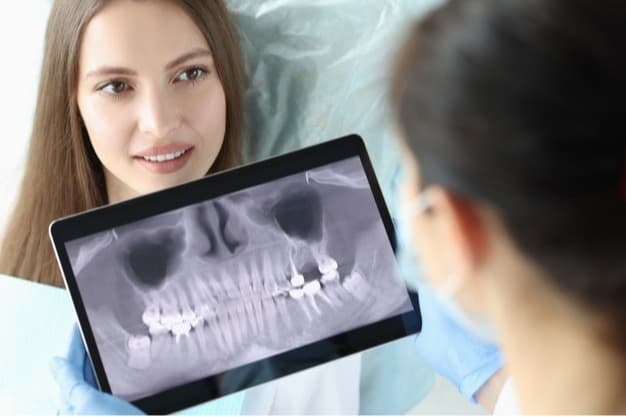
Digital dental imaging allows dentists to more accurately diagnose problems in the oral cavity and thus better plan and carry out treatments. This technology has many advantages over traditional imaging methods – it uses less radiation, which is better for patients, and also provides more precise images that allow dentists to better assess and treat oral problems.
Imaging (both types) can be organized at any stage of patient treatment quickly and efficiently.
2D digital imaging
2D digital dental imaging uses an x-ray machine to take two-dimensional images of teeth and surrounding tissues. This technology is useful for diagnosing periodontal diseases, as well as assessing the condition of tooth roots and bone defects and detecting carious lesions.
3D digital imaging
3D digital dental imaging, also known as CBCT (Cone Beam Computer Tomography), uses a low dose of x-ray radiation to create a three-dimensional image of the teeth and surrounding tissues. Through the third dimension of this image, it is possible to more securely identify the process, destruction, damage or deformity, and locate it more closely and accurately. Therefore, necessary surgical procedures can be better planned.